zoeyk
Posts:
2,395
Registered:
Mar 4, 2007
From:
San Francisco
Age:
45
Home page

|
|
Dead Stones. A community project.
Posted:
Oct 25, 2026, 3:44 AM
|
|
To listen to a shortened audio version of my post use this player, enjoy!
DEAD STONES PENTE
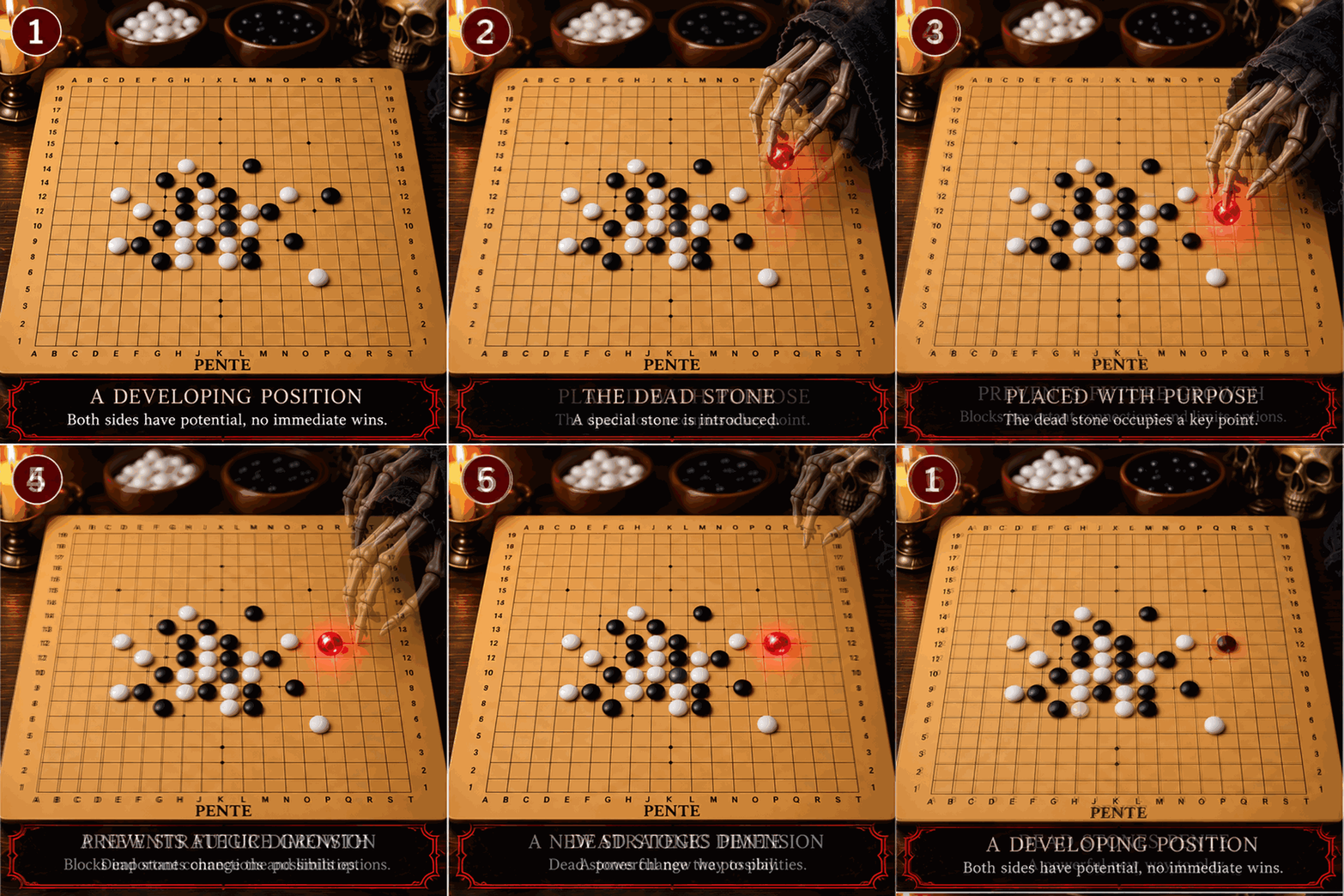 width="650"
alt="Dead Stones Pente Animated Demonstration">
A new dimension of strategy. Watch the dead stone come to life!
A New Pente Variant? Let's Create One Together — Dead Stones
Over a decade ago, I came up with an idea for a Pente variant
involving something I'll temporarily call "dead stones."
I never fully developed the concept, but I've always thought
it had some interesting strategic possibilities.
Rather than present a finished set of rules, I thought it
might be more interesting to bring the idea to the community
and see what we could come up with together.
Maybe we can collectively develop something that's not only
fun to play, but introduces an entirely new dimension of
positional strategy and tactical calculation.
The basic concept
Imagine traditional Pente, except we introduce a third type
of stone: a dead stone.
For now, let's imagine these stones are gray, distinguishing
them from the usual black and white. Their purpose would be
to occupy intersections, creating permanent obstacles that
neither player can use as their own stones.
They wouldn't belong to either player. They would simply
be dead intersections on the board.
That sounds simple enough, but consider the implications.
A strategically placed dead stone could disrupt an otherwise
winning formation, interfere with a developing attack, or
completely change the positional value of an area of the board.
And that's where things could get interesting.
When should dead stones enter the game?
One possibility would be to place them before the game begins,
with players alternating their placement while retaining
their assigned colors.
Something resembling the placement phase of Swap2, except
instead of choosing colors, players would be determining
the obstacles on the board before normal play begins.
However, I'm not convinced this would be the most interesting
approach. If the stones simply occupy popular opening
intersections, we might end up with something resembling
G-Pente's opening restrictions rather than a genuinely
new tactical variant.
Personally, I'm more intrigued by the possibility of
introducing dead stones after the opening has developed.
Traditionally, we can think of the opening as the positional
phase before the first forcing threats emerge, such as an
open three or a fukumi.
But programming a game to recognize every possible forcing
pattern, particularly the various forms of fukumi, could
be unnecessarily complicated.
A simpler solution might be to establish a fixed move number
after which dead stones become available.
But what move number?
And should that threshold be the same for both players?
How many dead stones should each player receive?
Here's another interesting question.
Should each player receive one dead stone per game? Two?
Perhaps several?
Or, considering the inherent first-player advantage in Pente,
what if only Player 2 received a dead stone?
Could this provide an interesting way of compensating for
Player 1's advantage without introducing complicated
opening restrictions?
Alternatively, both players could receive dead stones,
but perhaps not necessarily the same number.
There are several possibilities here, and I'm curious which
arrangement people think would produce the most balanced
and strategically interesting game.
Predictable placement windows — adding another layer of calculation
This is probably the aspect I find most intriguing.
What if players couldn't simply place their dead stones
whenever they wanted?
Suppose dead stones become available after a designated
opening phase, but can only be placed at specific,
predictable intervals.
For example:
• Only on certain odd or even moves.
• Every fifth move after the opening threshold.
• At other predetermined intervals that both players know in advance.
Imagine knowing that your opponent has a dead stone available,
but also knowing they cannot deploy it for another several moves.
You could calculate your tactical sequences around that
upcoming opportunity.
Conversely, you might deliberately develop a position that
forces your opponent to expend their dead stone defensively,
leaving them without that resource later.
This could create an entirely new strategic consideration:
not simply where to place a dead stone, but when to use it,
when to save it, and how to anticipate its eventual arrival.
The predictability of the placement windows would be important.
We wouldn't want dead stones to introduce so much uncertainty
that meaningful tactical calculation becomes impossible.
Ideally, they would add complexity without sacrificing the
calculative depth that makes Pente interesting.
A few other rules worth exploring
There are also some fundamental mechanics we would need
to decide.
Does placing a dead stone replace a player's normal move,
or is it an additional action?
Can a dead stone interrupt an existing line of stones?
Can it be placed between stones that would otherwise be
captured? And should dead stones themselves be completely
immune to capture?
Should certain intersections be off-limits?
These details could dramatically affect how the variant plays,
and I suspect some possibilities will prove much more
interesting than others once we start examining actual positions.
And finally, what should we call it?
"Dead Stones Pente" is just a working title.
Maybe someone can come up with something more imaginative,
memorable, or fitting.
Likewise, gray is only a placeholder for the stones'
appearance. Perhaps another color would be more visually
distinctive against black and white.
I'd be interested in hearing suggestions for both.
Let's see what we can create.
I'm deliberately leaving this concept unfinished because
I'd rather see the community participate in developing it
than simply present everyone with a predetermined set of rules.
What interests me most is whether we can introduce a new
strategic resource that rewards foresight, positional
understanding, and tactical calculation, while preserving
the fundamental character of Pente.
Maybe the best version uses one dead stone. Maybe several.
Maybe only Player 2 gets one. Maybe the placement intervals
become the defining feature of the entire variant.
I have my own thoughts, but I'd rather not steer the
discussion too heavily from the beginning.
So, what do you think?
If you could design this variant from scratch, how would you make dead stones work?
Let's see if we can turn an old idea into something worth playing.
|
|
Scire hostis animum - Intelligere ludum - Nosce te ipsum - Prima moventur conciliat - Nolite errare
|
|


